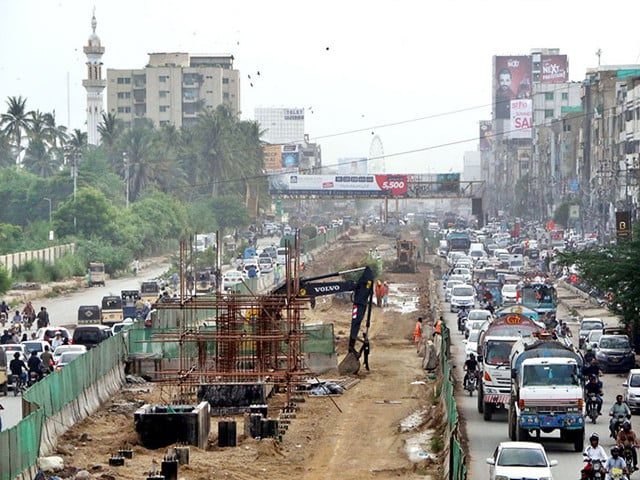
The Sindh High Court has ordered authorities to implement earlier directives on Karachi’s notified development plan and said KSDP 2020 will remain in force until a new plan is legally notified. In separate proceedings, the court also ordered inspection of a government school in Thatta, while an anti
KARACHI: The Sindh High Court’s constitutional bench on Wednesday issued a written order in a petition concerning implementation of the Karachi Strategic Development Plan 2020 (KSDP 2020), directing the Sindh government and other relevant authorities to fully comply with its earlier directions.
The two-member bench, headed by Justice Adnan-ul-Karim Memon, said the court’s order dated Feb 10, 2026, must be carried out in letter and spirit. It also recalled that on Feb 20, 2026, it had ordered notification of the Sindh Building Planning and Construction, Control and Demolition Rules within 90 days.
The bench ruled that KSDP 2020 would continue to remain in force until the Greater Karachi Plan 2047 is lawfully approved and notified. It further said that any departure from the notified plan would entail legal consequences.
According to the written order, the matter, prima facie, involved several institutions, policy issues and a legal framework that would ordinarily fall outside constitutional jurisdiction. However, the court noted that detailed directions had already been issued in February.
During the hearing, petitioner Tariq Mansoor Advocate argued that KSDP 2020 was the only notified development plan for Karachi since independence, but had still not been implemented after 18 years. He told the court that under the policy, 32 institutions were to be devolved to local governments, and alleged that the Sindh government was trying to mislead the court.
He further claimed that land reserved for projects including a new airport and Education City had been encroached upon. He also alleged that a new development plan was being introduced to hide corruption of Rs8 trillion, and said Rs1 billion had been allocated for preparation of a new plan.
The government counsel, however, told the court that the 2020 plan had been delayed and that work on the Greater Karachi Plan 2047 was in progress. He added that about 60 per cent of the work had been completed under the supervision of international experts.
Thatta school inspection ordered
In a separate matter, the constitutional bench ordered an inspection of a government school in Thatta over allegations regarding the absence of teachers, lack of a building and missing basic facilities, and directed the deputy commissioner to submit a report.
Hearing a petition about the shortage of educational facilities, counsel for the petitioner argued that although official records showed teachers posted at the school, none were actually present. He also submitted that the school did not have a proper building and that even students in class five were unable to read basic alphabets.
The court directed the deputy commissioner of Thatta to have the assistant commissioner carry out a site visit to examine the availability of infrastructure, the presence of teaching staff and other essential facilities. It also ordered that copies of its directions be sent to the secretary education and instructed that a compliance report be submitted to the MIT. The petition was disposed of after these directions were issued.
MQM leader gets bail in Tahir Plaza case
Separately, a special anti-terrorism court approved bail for Muttahida Qaumi Movement leader Ahmed Saeed, also known as Saeed Bharm and Nagori, in the Tahir Plaza arson case.
Special Court No. 6 at the Anti-Terrorism Complex inside Central Jail Karachi announced its decision on the bail application and directed the accused to furnish surety bonds of Rs300,000.
Defence counsel Advocate Mushtaq Ahmed argued that another accused, Faisal Javaid alias Mumma, who had identified Ahmed Saeed, had already been granted bail by the high court. He further said Ahmed Saeed had been challaned on the basis of the testimony of another accused, Imran alias Saeed.