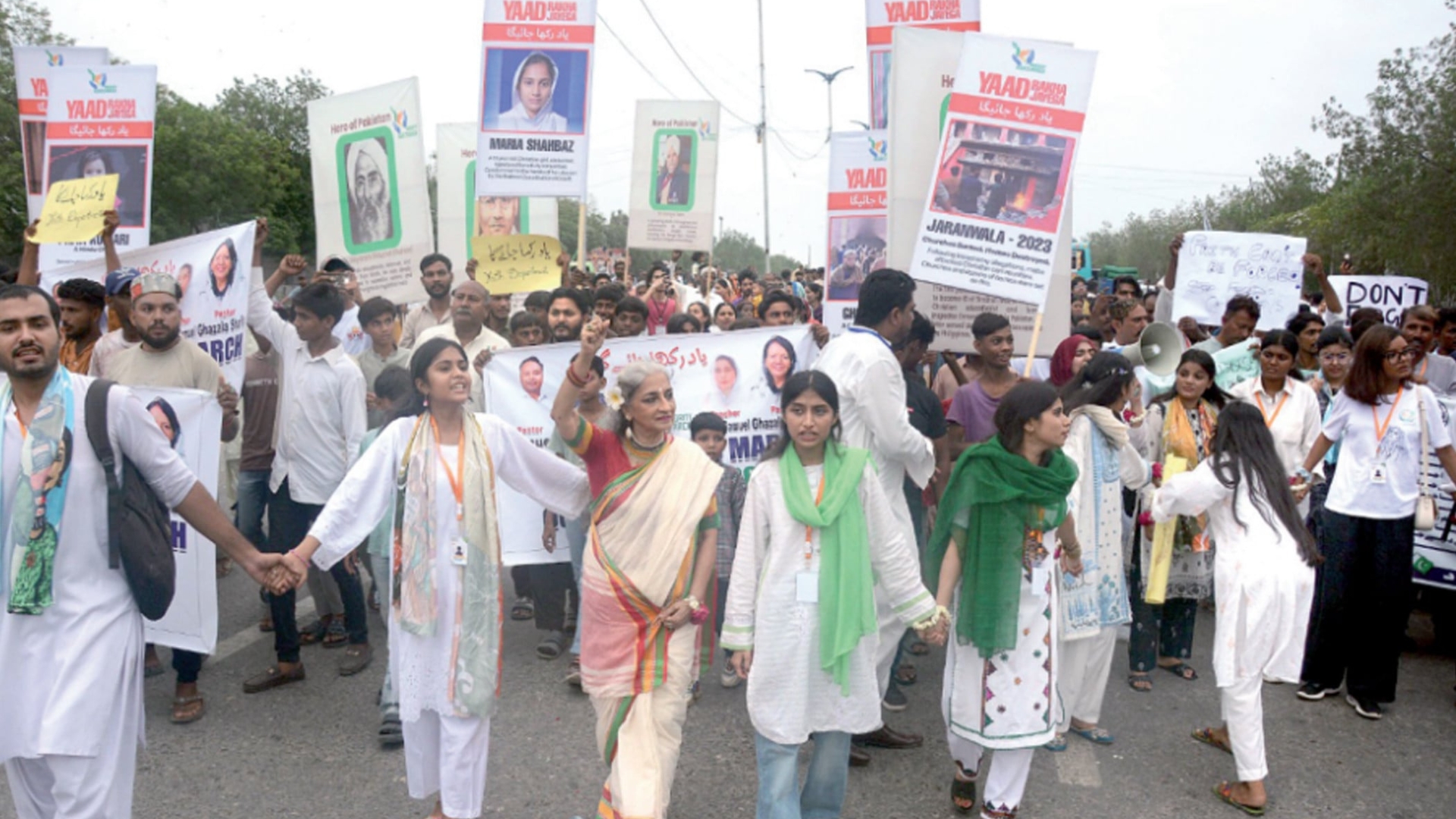
A protest outside Mazar-e-Quaid on National Minorities Day called for criminalising forced conversions and accepting an 11-point charter on minority rights. Demonstrators also sought wider education and job quotas and constitutional reforms.
KARACHI: Rights activists and community leaders gathered outside Mazar-e-Quaid on National Minorities Day to demand legal and political reforms for religious minorities, including criminalising forced conversions, expanding quotas in education and employment, and amending constitutional provisions that bar minorities from the offices of president and prime minister.
The protest, organised by the Minority Rights March with participation from civil society representatives, drew figures including Sheema Kermani, Pastor Ghazala Shafiq, Dr Vinesh Arya, Sajjal Shafiq, Nathan Daniyal and Anwar Sheikh. Speakers said the treatment of minorities in Pakistan today ran counter to Quaid-e-Azam Muhammad Ali Jinnah’s August 11, 1947 address and had deepened fear, insecurity and frustration, especially among younger members of minority communities.
Key demands
The demonstrators urged the government to accept an 11-point charter centred on equal citizenship, an end to religious discrimination and action against violent extremism. Among the proposals was a minimum 10% quota for minorities in all public and private educational institutions, in addition to merit and other existing quotas, as well as the release of minority educational institutions from national control.
They also called for the removal of discriminatory and hate-based material from curricula and textbooks, with greater emphasis on respect for minorities, tolerance, peace and religious diversity. Another demand sought replacing the term “non-Muslim” in the Constitution and other laws with specific religious identities.
The charter further asked for amendments to Articles 41 and 91 so members of religious minorities could become president and prime minister, and for oath-taking procedures for all faiths to be included in official oaths of office. Protesters also called for more reserved seats for minorities at the federal, provincial and local levels, stronger minority representation in the senior ranks of political parties, and electoral reforms requiring every political party to field minority candidates for at least 10% of general seats and one-third of seats reserved for women.
Conversions, jobs and places of worship
A central demand of the march was for forced conversion to be declared a criminal offence. The participants also sought changes to personal laws governing interfaith marriages to safeguard the rights of minority spouses and children.
On employment, the protesters demanded a 10% quota for minorities at all levels in public and private offices and called for an end to the practice of confining minorities to sanitation and other menial work. They also pressed for the protection and restoration of minority places of worship and properties, digitisation of records, and implementation of the Supreme Court’s 2014 judgment through national and provincial minority rights commissions.
Participants carried placards highlighting the issues faced by religious minorities and calling for stronger protection of their rights.